


HS Code classification: The hidden bottleneck in international commerce
The Hidden Risk in Your International Supply Chain
If you're shipping products across borders, HS code classification is either costing you time, money, or both. Here's how to turn a compliance headache into an automated workflow.
What Is an HS Code?
Every product that crosses an international border needs a Harmonized System (HS) code. These six-to-ten digit codes determine the tariffs applied to your goods, the customs documentation required, and whether your shipment clears customs smoothly or gets held up at the border. Get the code wrong and you risk overpaying duties, facing fines, or watching your inventory sit in a warehouse while paperwork gets sorted out.
For businesses that sell a handful of products, managing HS codes is tedious but manageable. For businesses with hundreds or thousands of SKUs shipping to multiple countries, it becomes a serious operational challenge.
The Problem With Manual HS Code Management
Most eCommerce and retail businesses handle HS code classification manually. Someone on the team looks up the correct code for each product, enters it into the system, and hopes it stays accurate as regulations change. This approach breaks down quickly for a few reasons.
Classification is genuinely complex. The Harmonized System contains over 5,000 commodity groups across 97 chapters. A cotton t-shirt with a printed graphic is classified differently from a plain cotton t-shirt. A product that contains 51% polyester and 49% cotton falls into a different category than one with the reverse composition. These distinctions matter because they directly affect the duty rate applied at customs.
Regulations change. Countries update their tariff schedules regularly. A code that was correct six months ago might not be correct today. Staying current across multiple destination countries requires constant monitoring, and most businesses simply don't have the resources to do this proactively.
Mistakes are expensive. Incorrect HS codes can lead to under-declaration (which triggers penalties and audits) or over-declaration (which means you're paying more in duties than you need to). Neither outcome is good. For high-volume shippers, even a small percentage of misclassified products adds up to significant cost over time.
Documentation is scattered. HS codes don't exist in isolation. They feed into customs declarations, commercial invoices, certificates of origin, and other trade documents. When codes are managed in spreadsheets or disconnected systems, keeping all of these documents consistent becomes an exercise in manual cross-referencing.
Where Automation Changes the Game
The solution isn't to become an expert in customs classification. It's to build systems that handle the complexity for you and flag exceptions when human judgment is needed. This is where workflow orchestration becomes valuable.
An automated HS code workflow addresses the problem at every stage of the product lifecycle, from initial classification through to shipment documentation.
At product creation, every new SKU gets assigned an HS code as part of the onboarding process. Instead of this being a manual lookup, the workflow can pre-populate codes based on product attributes like category, material composition, and intended use. Edge cases get flagged for manual review rather than slipping through unnoticed.
At order time, when an international shipment is triggered, the workflow automatically pulls the product's HS code, calculates applicable tariffs for the destination country, and generates the required customs documentation. No one needs to remember to do this. It happens as a natural part of the fulfilment process.
On an ongoing basis, workflows can monitor for regulatory changes and flag products whose classifications may need updating. Instead of discovering a problem at the border, you catch it in advance and correct it before it affects a shipment.
How Cargo Pilot Handles HS Code Classification
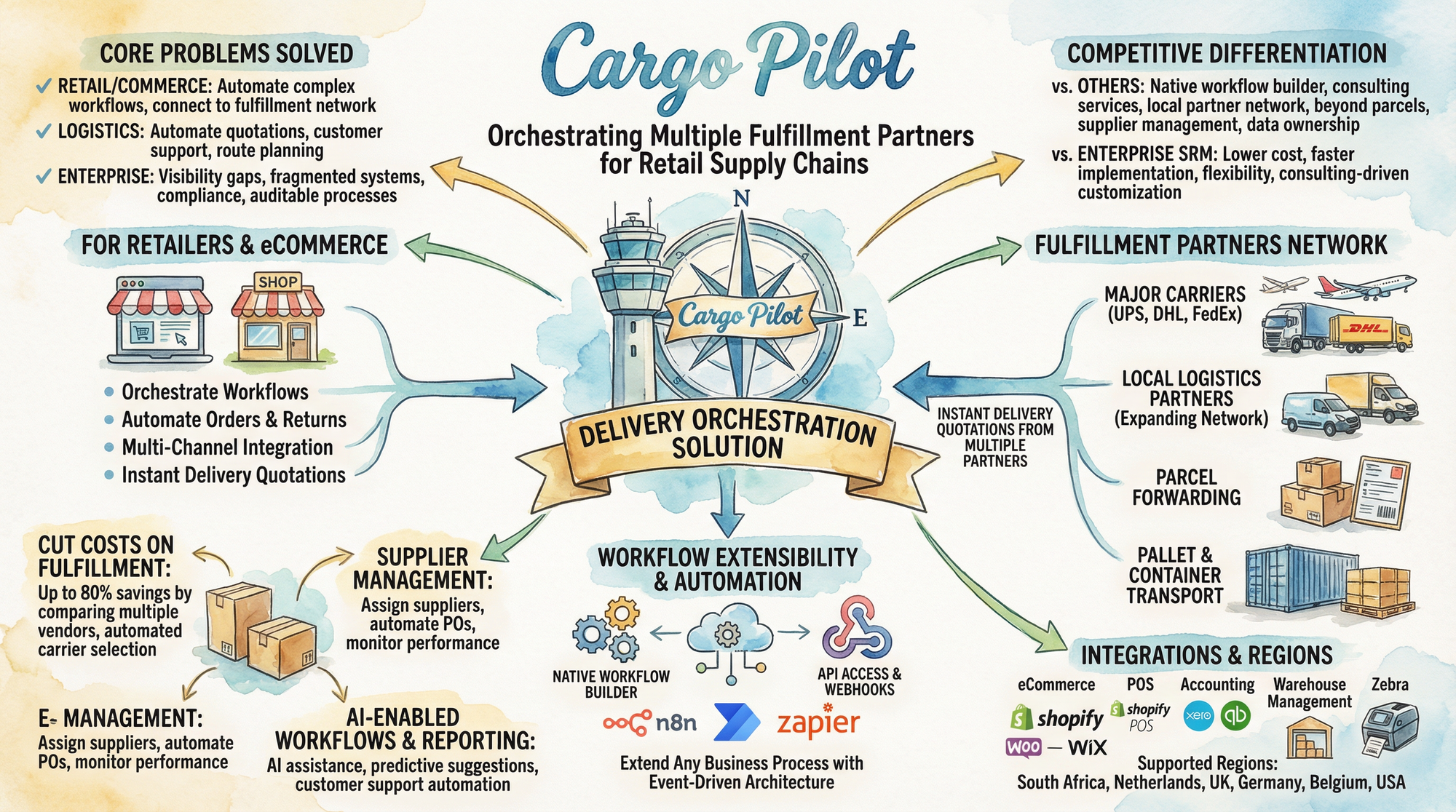
Cargo Pilot is built around this kind of workflow orchestration. Here's how the HS code classification process works within the platform.
Product Catalogue as the Foundation
Every product in Cargo Pilot carries its HS code as a core attribute. Whether products are synced from Shopify, WooCommerce, BigCommerce, or entered manually, the HS code is part of the product record. This means classification data lives alongside the product rather than in a separate spreadsheet or compliance system.
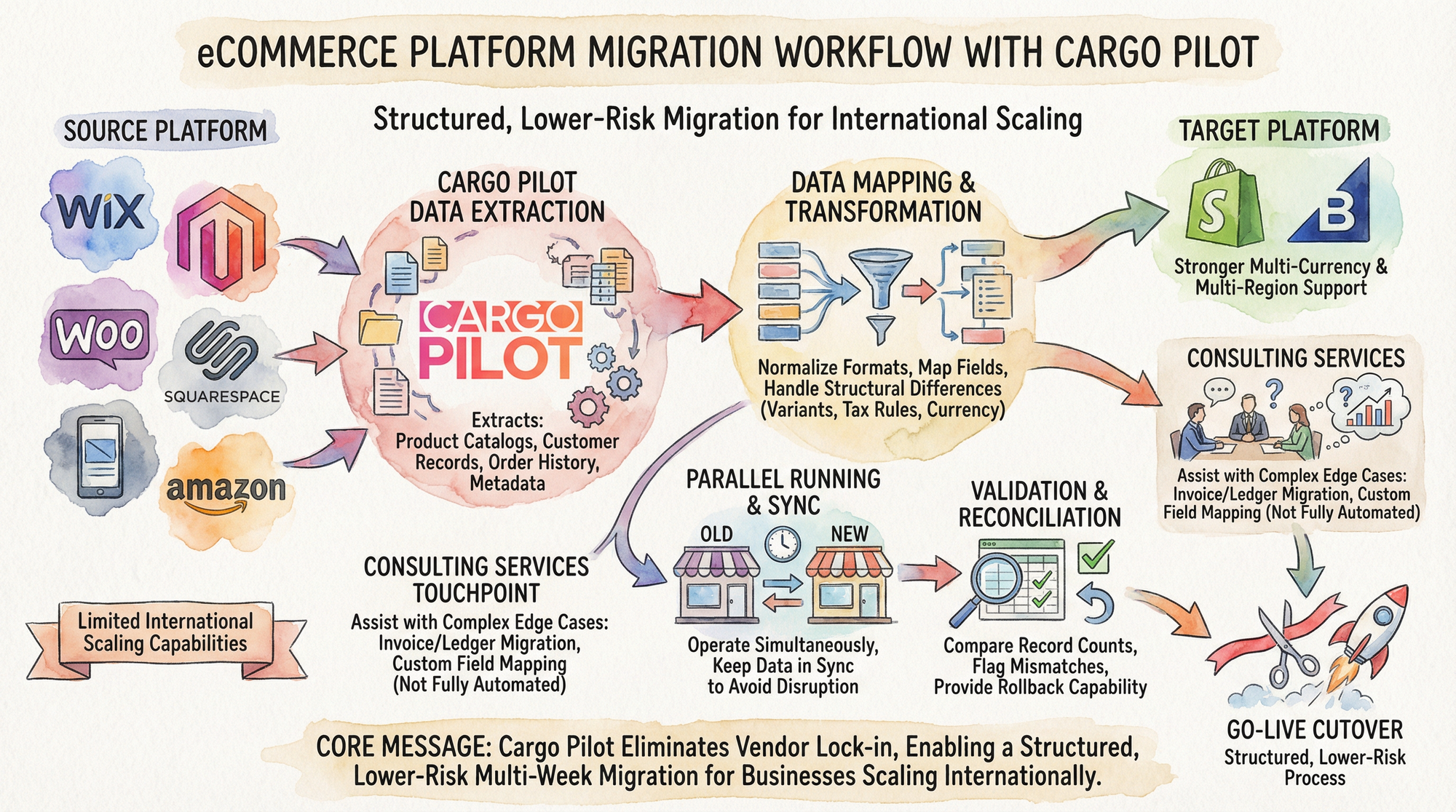
For businesses migrating to Cargo Pilot from another platform, existing HS code data is preserved during the migration process. For businesses that don't yet have codes assigned, Cargo Pilot provides the structure to build out classifications systematically.
Event-Driven Compliance Workflows
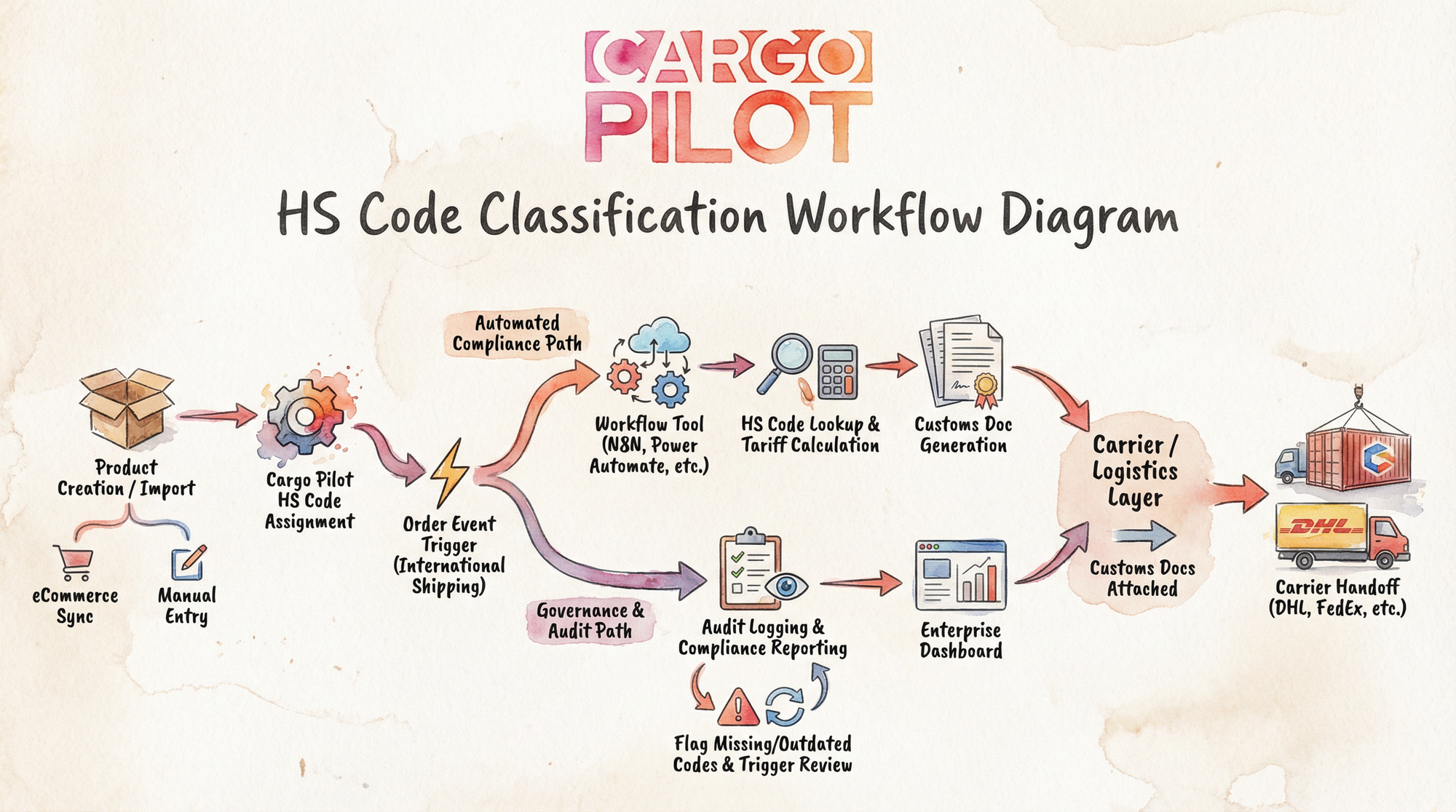
Cargo Pilot's event-driven architecture is where the real value lies. When an order is placed that involves international shipping, that event can trigger a compliance workflow. Using integration tools like N8N, Power Automate, or Zapier, you can build workflows that:
- Look up the product's HS code from the Cargo Pilot product catalogue
- Calculate tariffs based on the destination country and the applicable trade agreements
- Generate customs declarations and commercial invoices with the correct codes pre-populated
- Attach the documentation to the shipment record before carrier handoff
- Route exceptions (products with missing or flagged codes) to a compliance team member for review
These workflows run automatically every time the triggering event occurs. There's no manual step, no forgotten documentation, and no last-minute scramble to find the right paperwork.
Audit Trails and Governance
For businesses that need to demonstrate compliance, particularly larger organizations or those in regulated industries, Cargo Pilot maintains audit trails on HS code assignments and changes. You can see when a code was assigned, when it was changed, and by whom. This is critical for customs audits, where regulators want to see documented processes rather than ad hoc decisions.
Workflow governance features also allow you to enforce business rules. For example, you can build a rule that prevents a shipment from being dispatched if the product's HS code is missing or hasn't been reviewed within a specified timeframe. This kind of proactive enforcement catches problems before they reach the border.
Carrier Integration With Compliance Data
When Cargo Pilot routes a shipment to a carrier like DHL, FedEx, or a regional logistics partner, the HS code and associated customs documentation travel with the shipment data. The carrier receives everything they need to process the customs declaration without requiring additional input from your team.
This integration between the compliance workflow and the carrier network is what makes the process genuinely end-to-end. Classification, documentation, and shipping are connected rather than existing as separate, disconnected steps.
What This Looks Like in Practice
Consider a mid-size retailer based in the Netherlands selling to customers across Europe, the UK, and South Africa. Their product catalogue includes 800 SKUs across multiple categories. Each destination country has different duty rates and documentation requirements.
Without automation, every international order requires someone to verify the HS code, calculate the applicable duty, generate the customs paperwork, and attach it to the shipment. For a business processing hundreds of orders per week, this is a full-time job.
With Cargo Pilot, the process works like this:
- Products are created or synced with HS codes as part of the product record
- An international order comes in through Shopify
- Cargo Pilot's event system detects the order and triggers the compliance workflow
- The workflow pulls the HS code, calculates tariffs for the destination, and generates customs documentation
- The documentation is attached to the shipment
- Cargo Pilot selects the best carrier based on cost and delivery speed, passing along the compliance data
- The shipment is dispatched with all documentation in order
The entire process from order to dispatch happens without manual compliance intervention. Exceptions are routed to the right person. Everything is logged.
Beyond Classification: The Bigger Picture
HS code management doesn't exist in a vacuum. It's one part of a broader set of compliance and operational challenges that come with international commerce. Cargo Pilot's approach treats it as exactly that: one workflow among many that can be automated and orchestrated.
The same event-driven architecture that handles HS code classification also powers fulfilment automation, supplier management, stock reconciliation, and customer communications. Adding compliance workflows to your existing Cargo Pilot setup doesn't require a separate system or a new vendor relationship. It's an extension of the orchestration you're already doing.
For businesses that are already using Cargo Pilot for domestic operations and looking to expand internationally, the compliance infrastructure is ready to go. For businesses that are already shipping internationally and struggling with manual processes, Cargo Pilot provides a path to automation that scales with your catalogue and your geographic footprint.
Getting Started
If HS code management is consuming your team's time or causing problems at the border, the first step is a conversation about your specific products, destinations, and compliance requirements. Cargo Pilot's consulting team has experience building customs and compliance workflows across multiple jurisdictions and can help map out an approach that fits your operations.
Book a discovery call: cargopilot.net/contact