

HS Code Classification
The Hidden Risk in Your International Supply Chain
If you're shipping products across borders, there's a six-digit code that can make or break your profitability. Get it right, and your goods clear customs smoothly with the correct duties applied. Get it wrong, and you're looking at delays, penalties, seized shipments, and retroactive duty payments that can wipe out your margins.
That code is the Harmonized System (HS) code, and for many businesses expanding into international commerce, it's one of the most overlooked compliance risks in their supply chain.
What Is an HS Code?
The Harmonized System is an international nomenclature developed by the World Customs Organization (WCO) for classifying traded products. It's used by customs authorities in over 200 countries to determine what tariffs and regulations apply to goods crossing their borders.
Every product that moves internationally needs an HS code. The system uses a standardized six-digit classification at the international level, with individual countries adding additional digits for more granular classification. For example, the EU uses an eight-digit CN (Combined Nomenclature) code, while the US uses a ten-digit HTS (Harmonized Tariff Schedule) code.
The structure works hierarchically. The first two digits identify the chapter (broad product category), the next two identify the heading (more specific grouping), and the final two identify the subheading (specific product type). Additional country-specific digits provide further detail for national tariff and statistical purposes.
A simple example: fresh apples fall under HS code 0808.10. The 08 indicates edible fruit and nuts, 08.08 narrows it to apples, pears, and quinces, and 0808.10 specifies fresh apples specifically.
Why HS Code Classification Matters
Duty Rates and Cost Impact
The most immediate impact of HS classification is on duty rates. Different codes carry different tariff percentages, and the difference can be substantial. A product classified under one code might attract a 5% duty, while a similar product under a different code could face 25% or more.
For businesses operating on tight margins, especially in eCommerce and retail, incorrect classification can turn a profitable product line into a loss-maker overnight. And because duties are calculated on the customs value of goods, the financial impact scales with your volume.
Compliance and Penalties
Customs authorities take classification seriously. Incorrect HS codes, whether from negligence or intent, can result in penalties ranging from fines to seizure of goods. In some jurisdictions, repeated misclassification can trigger audits of your entire import history, with retroactive duty assessments and interest charges.
The compliance burden extends beyond duties. HS codes determine which regulatory requirements apply to your products, including safety standards, labelling requirements, and import licensing. A misclassified product might clear customs initially but create compliance issues downstream.
Trade Agreements and Preferential Rates
Many businesses don't realize that HS codes are the gateway to preferential duty rates under free trade agreements. If you're importing goods that qualify for reduced or zero duties under an FTA, you need the correct HS code to claim that preference.
Incorrect classification can mean paying full duties on goods that should have cleared at preferential rates. Conversely, claiming preferences on incorrectly classified goods can trigger compliance issues if audited.
Supply Chain Visibility and Planning
Beyond compliance, accurate HS codes enable better supply chain planning. They're essential for landed cost calculations, which determine the true cost of getting products to your warehouse or customer. Without accurate classification, your cost projections are guesswork.
HS codes also feed into trade analytics and reporting. Understanding your tariff exposure by product category helps with sourcing decisions, pricing strategy, and market entry planning.
The Classification Challenge
If HS codes are so important, why do so many businesses get them wrong?
Complexity and Ambiguity
The Harmonized System contains over 5,000 commodity groups, organized across 97 chapters. Finding the right classification requires understanding both your product and the classification rules, which aren't always intuitive.
Products that combine multiple materials or functions are particularly tricky. A backpack with integrated solar panels for charging devices: is it luggage, electrical equipment, or something else? The answer depends on the product's essential character, which is often a judgment call.
Product Evolution
Businesses add new products, modify existing ones, and source from different suppliers. Each change potentially affects classification. A minor reformulation or component change can shift a product into a different HS code with different duty implications.
Keeping classifications current across a growing product catalog is an ongoing challenge, not a one-time exercise.
Supplier Dependence
Many businesses rely on suppliers or freight forwarders to provide HS codes. This creates risk. Suppliers may not understand destination country requirements, and freight forwarders are often working from limited product information. The importer of record remains responsible for correct classification regardless of who provided the code.
Jurisdictional Variations
While the first six digits of HS codes are internationally harmonized, the additional digits used by individual countries are not. A product classified correctly for EU import may need a different extended code for US import. Businesses selling internationally need to manage multiple classification schemes.
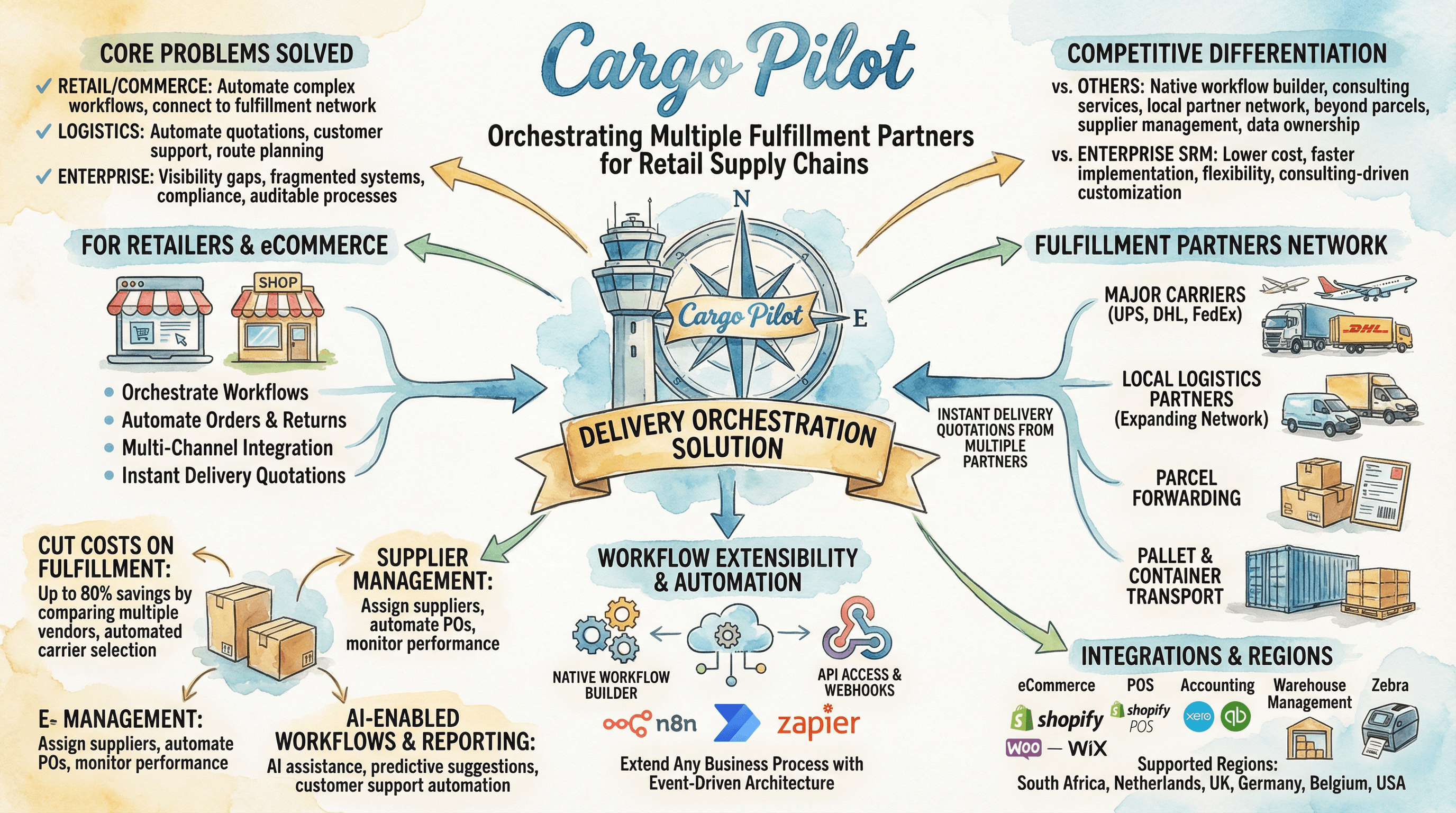
How Cargo Pilot Helps Manage HS Code Complexity
Managing HS codes effectively requires a systematic approach: maintaining accurate product data, keeping classifications current, and ensuring the right codes flow through to shipping documentation and customs declarations. This is where Cargo Pilot's product management and workflow capabilities come into play.
Centralized Product Classification
Cargo Pilot allows you to manage HS codes directly within your product catalog. Rather than tracking classifications in spreadsheets or relying on information scattered across systems, you maintain a single source of truth for each product's customs classification. The HS code is stored at the product level, meaning once it is set that HS code can be re-used across all your integrations with Cargo Pilot.
This centralization matters because HS codes need to flow consistently to multiple downstream processes: commercial invoices, packing lists, customs declarations, and carrier documentation. When your product master contains accurate classification data, that accuracy propagates through your entire fulfillment workflow. This saves you time and potentially avoiding costly fines when navigating the customs and declarations process.
Multi-Market Classification Support
For businesses shipping to multiple countries, Cargo Pilot supports managing the extended classification codes required by different jurisdictions. You can maintain the base six-digit HS code alongside the country-specific extensions needed for your target markets.
This is particularly valuable for businesses operating across regions like the EU, UK, and US, where the same product may need different extended codes for each market. Rather than managing separate classification systems, you maintain comprehensive product data in one place. This means that the HS code can be used to do a lookup against that countries HSM catalog to do the relevant duty/tariff calculations.
Import/Export Workflow Automation
Cargo Pilot's workflow orchestration capabilities extend to customs and trade compliance. You can build workflows that ensure correct HS codes are included in shipping documentation, flag products that lack classification data, or route orders through compliance checks based on destination country.
For example, you might create a workflow that automatically holds international orders for products without valid HS codes, preventing shipments from going out with incomplete customs information. Or a workflow that flags high-duty products for review before shipping to specific markets.
Supplier and Procurement Integration
Because Cargo Pilot includes supplier management capabilities, you can track which suppliers provide which products and ensure classification data is captured as part of your procurement process. When onboarding new products or suppliers, workflows can enforce that HS codes are provided and validated before products enter your catalog.
This is particularly useful for businesses with large or frequently changing product ranges. Rather than treating classification as an afterthought, it becomes an integrated part of your product and supplier onboarding process.
Reporting and Audit Readiness
Accurate HS codes in your product master enable meaningful trade reporting. You can analyze your tariff exposure by product category, identify products with high duty rates that might benefit from tariff engineering or alternative sourcing, and maintain the documentation needed if customs authorities request classification evidence.
Cargo Pilot's data ownership philosophy means you have full access to your product and order data, including classification information. This supports both operational reporting and the audit trails that customs compliance requires.
Best Practices for HS Code Management
Beyond using the right tools, effective HS code management requires good practices.
Invest in Initial Classification
Getting classifications right upfront is far cheaper than fixing them later. For complex products or high-volume SKUs, consider engaging a licensed customs broker or trade compliance specialist for initial classification. The cost of professional classification is typically a fraction of the duty exposure from misclassification.
Document Your Reasoning
For each classification decision, document why you chose that code. Include product descriptions, technical specifications, and the classification logic. This documentation supports your position if customs authorities question your classification and helps maintain consistency when classifying similar products.
Review Regularly
HS codes aren't static. The WCO updates the Harmonized System periodically, and country-specific codes change more frequently. Build regular classification reviews into your compliance calendar, particularly for high-value or high-volume products.
Train Your Team
Anyone involved in product sourcing, catalog management, or shipping operations should understand the basics of HS classification and why it matters. They don't need to be classification experts, but they should know enough to recognize when products need classification review and when to escalate questions.
Integrate Classification into Product Lifecycle
Don't treat HS codes as shipping documentation. Treat them as product master data. Classification should be part of new product introduction, captured alongside other product attributes like dimensions, weight, and cost. When products change, classification review should be part of the change management process.
The Bottom Line
HS code classification is one of those operational details that's easy to overlook until it creates a problem. But for businesses engaged in international commerce, getting classification right is fundamental to cost control, compliance, and supply chain efficiency.
The challenge is that classification touches multiple functions: product management, procurement, logistics, finance, and compliance. Without a systematic approach and the right tools, it's easy for classification data to become fragmented, outdated, or simply wrong.
Cargo Pilot provides the product management foundation and workflow capabilities to bring HS code management under control. By centralizing classification data, integrating it with your fulfillment workflows, and connecting it to your supplier and procurement processes, you can turn a compliance headache into a managed business process.
If you're expanding into international markets or looking to tighten up your trade compliance, get in touch. We can help you assess your current classification practices and show you how Cargo Pilot's capabilities map to your requirements.